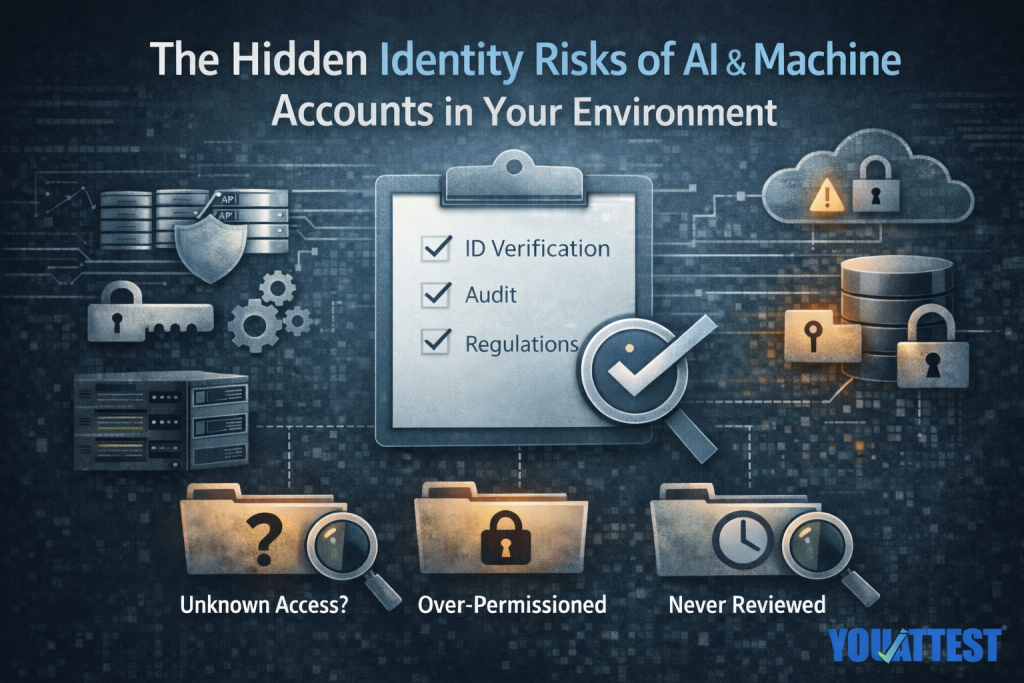
When most organizations think about identity risk, they’re thinking about people: employees, contractors, partners, and former users who still have access.
But in modern environments, humans are no longer the dominant identity type.
Service accounts, API keys, automation bots, and AI agents now outnumber human users in many enterprises — and most of them aren’t governed at all.
That’s a problem.
Because attackers don’t care whether an identity belongs to a person or a process. They care whether it gives them access.
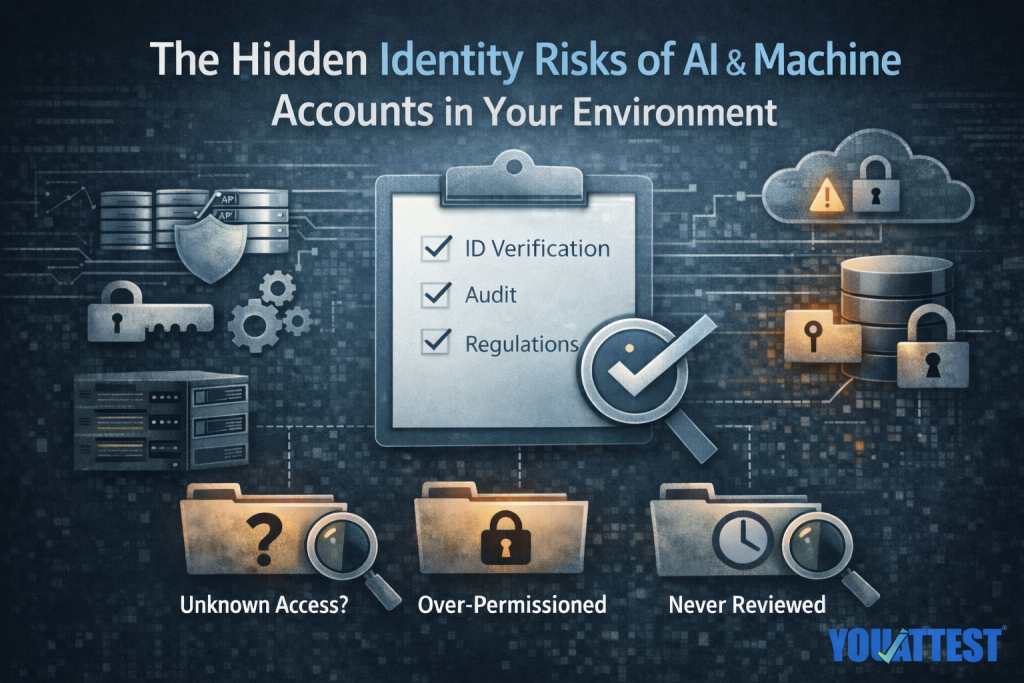
Image 01: YouAttest automates the key accounts for AI service accounts and other NHIs (Non-Human Identities)
Non-Human Identities Are Everywhere (Whether You Like It or Not)
Non-human identities include:
- Service accounts running applications and background jobs
- API keys connecting SaaS platforms and cloud services
- Automation bots handling workflows, provisioning, and scripts
- AI agents accessing data to train models, answer questions, or take actions
These identities are critical to operations — but they’re also:
- Rarely documented
- Often over-permissioned
- Almost never reviewed
- Frequently created without an expiration date
In many environments, these identities quietly accumulate over time until no one is quite sure why they exist, what systems or data they can access, or whether they’re still needed at all.
Why Machine Accounts Are a Perfect Target
From an attacker’s perspective, non-human identities are ideal:
- They don’t log in interactively
- They aren’t tied to a person who might notice suspicious activity
- They often have broad, persistent permissions
- They’re rarely monitored or reviewed
A compromised service account or API key can provide silent, long-term access — exactly what attackers want.
And unlike human accounts, these identities often bypass normal controls like MFA, conditional access, or behavioral monitoring.
Why Traditional Access Reviews Miss the Problem
Most access review programs were designed with people in mind. Managers are expected to certify employee access, HR systems trigger joiner, mover, and leaver workflows, and reviews typically run on a quarterly or annual cadence. Machine identities don’t fit neatly into this model.
They don’t have managers, they don’t change roles, and they never “leave” the organization. As a result, they often fall outside normal access review cycles and outside everyday visibility. That doesn’t make them lower risk — it makes them less visible risk, which is often far more dangerous.
The Compliance Blind Spot
From a compliance standpoint, unmanaged machine identities are a ticking time bomb.
Auditors increasingly ask:
- “How do you know this account is still required?”
- “Who approved this access?”
- “When was it last reviewed?”
- “How do you detect excessive or stale permissions?”
Answering those questions with:
“It’s a service account — we don’t really review those”
…doesn’t go over well.
As regulations tighten and audits mature, non-human identities are becoming part of the access governance conversation, whether organizations are ready or not.
Governing Machine Identities Like a Grown-Up
The solution isn’t to stop using service accounts, APIs, or AI agents.
The solution is to govern them intentionally.
That means:
1. Bring Machine Identities Into Access Reviews
Service accounts and AI identities should be:
- Inventoried
- Categorized
- Reviewed on a regular cadence
They don’t need the same workflow as humans — but they do need accountability.
2. Assign Ownership
Every non-human identity should have a clear owner:
- An application owner
- A system owner
- A security or platform team
Someone must be responsible for certifying:
- Why it exists
- What it can access
- Whether that access is still appropriate
3. Detect Over-Permissioning
Machine identities often accumulate access “just in case.”
Automated reviews help surface:
- Excessive group memberships
Privileged access that no longer makes sense - Access that exceeds the identity’s functional purpose
4. Produce Audit-Ready Evidence
When auditors ask for proof, you need more than tribal knowledge.
You need:
- Review history
- Approval records
- Evidence of ongoing governance
Automation makes this sustainable.
Identity Governance Is the Missing Layer for AI Security
Organizations talk a lot about securing AI:
- Model security
- Data privacy
- Prompt injection
- Output validation
But none of that matters if the identity behind the AI is over-privileged and unmanaged.
AI security starts with identity governance.
If you don’t know:
- Which identities your AI uses
- What they can access
- Whether that access is reviewed
You don’t really control your AI risk.
Final Thought: If It Has Access, It Needs Governance
- Human or machine
- User or AI
- Employee or service account
If an identity can access your systems, data, or applications — it needs governance.
Organizations that recognize this early will:
- Reduce breach risk
- Simplify audits
- Enable AI safely
- Stay ahead of regulators
Those that don’t will keep discovering access they didn’t know existed — usually at the worst possible time.
Want to see all identities in your environment — human and non-human — and review them without spreadsheets or chaos?
YouAttest helps organizations automate access reviews, uncover hidden identity risk, and stay audit-ready as identity continues to evolve. Contact us – and let us help you identify and attest to these important accounts.

- AI Agents Are Privileged Identities. Their Access Needs to Be Reviewed. - October 3, 2026
- AI Is the Unrealized Insider Threat: Why Enterprise AI Security Starts With Existing User Access - September 20, 2026
- The Service Account Wasn’t the Initial Breach. It Became Part of the Attack. - September 13, 2026